Learning

Natural product-based regenerative therapy for improving cognitive deficits in aged individuals: Sulforaphane, isolated from Broccoli and others, decreases vascular cell adhesion molecule 1 (VCAM 1), inhibits microglia activity, increases hippocampal neural precursor activity, ameliorates cognition, & attenuates age-related neurodegeneration, through up regulation of its target genes, 14/June/2019, 6.31 am

Natural product-based regenerative therapy for improving cognitive deficits in aged individuals: Sulforaphane, isolated from Broccoli and others, decreases vascular cell adhesion molecule 1 (VCAM 1), inhibits microglia activity, increases hippocampal neural precursor activity, ameliorates cognition, & attenuates age-related neurodegeneration, through up regulation of its target genes, 14/June/2019, 6.31 am 960 720 Dr Boomi's Genom-2-Discovery Center

Introduction: What they say A study from the Department of Neurology and Neurological Sciences, Stanford University School of Medicine, Stanford, CA, USA, VA Palo Alto Health Care System, Palo Alto,…

read more
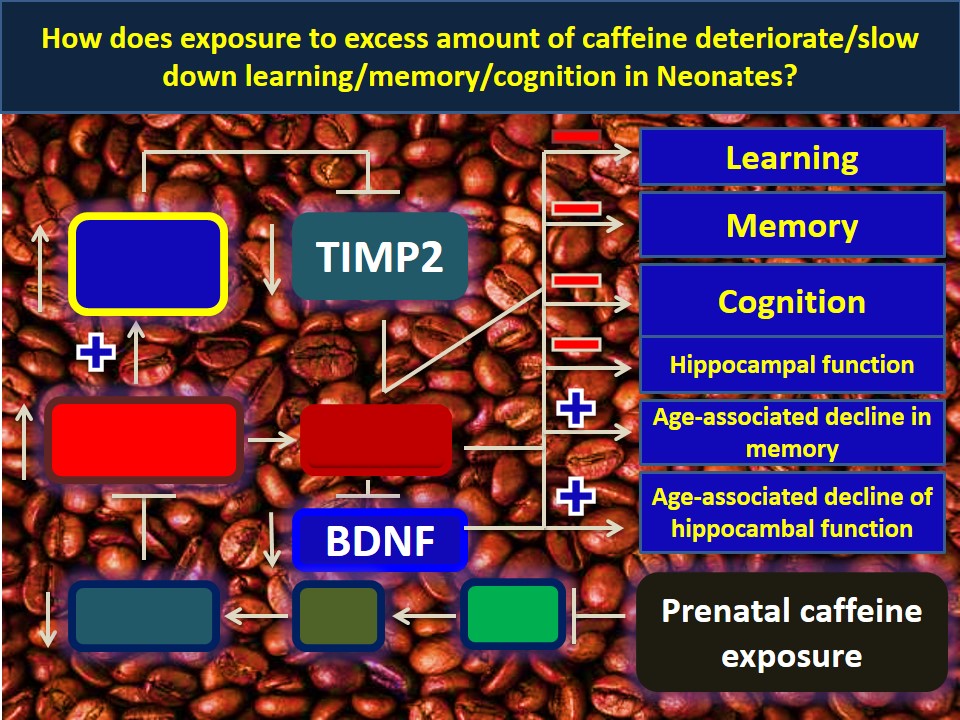
Mechanistic insights into how consumption of excess amount of coffee during pregnancy may deteriorate memory, learning, and cognition of fetus in the womb:  Caffeine, one of the main components of coffee, decreases Tissue inhibitor of metalloproteinases 2 (TIMP2) and BDNF (Brain derived growth factor) levels, attenuates cognition, and aggravates age-associated decline in memory and learning, via up-regulation of its target genes, 22/May/2019, 11.14 pm

Mechanistic insights into how consumption of excess amount of coffee during pregnancy may deteriorate memory, learning, and cognition of fetus in the womb:  Caffeine, one of the main components of coffee, decreases Tissue inhibitor of metalloproteinases 2 (TIMP2) and BDNF (Brain derived growth factor) levels, attenuates cognition, and aggravates age-associated decline in memory and learning, via up-regulation of its target genes, 22/May/2019, 11.14 pm 960 720 Dr Boomi's Genom-2-Discovery Center

Introduction: What they say A study from Department of Neurology and Neurological Sciences, Stanford University School of Medicine, Stanford, California 94305, USA;  Paul F. Glenn Center for the Biology of…

read more

Ribonucleic acid-based therapy for enhancing memory and cognition: LncRNA CCDC26  increases Tissue inhibitor of metalloproteinases 2 (TIMP2) levels, improves cognition, and decreases age-associated decline in memory and learning, via down-regulation of its target genes, 17/May/2019, 11.55 pm

Ribonucleic acid-based therapy for enhancing memory and cognition: LncRNA CCDC26  increases Tissue inhibitor of metalloproteinases 2 (TIMP2) levels, improves cognition, and decreases age-associated decline in memory and learning, via down-regulation of its target genes, 17/May/2019, 11.55 pm 960 720 Dr Boomi's Genom-2-Discovery Center

Introduction: What they say: A study from Department of Neurology and Neurological Sciences, Stanford University School of Medicine, Stanford, California 94305, USA;  Paul F. Glenn Center for the Biology of…

read more

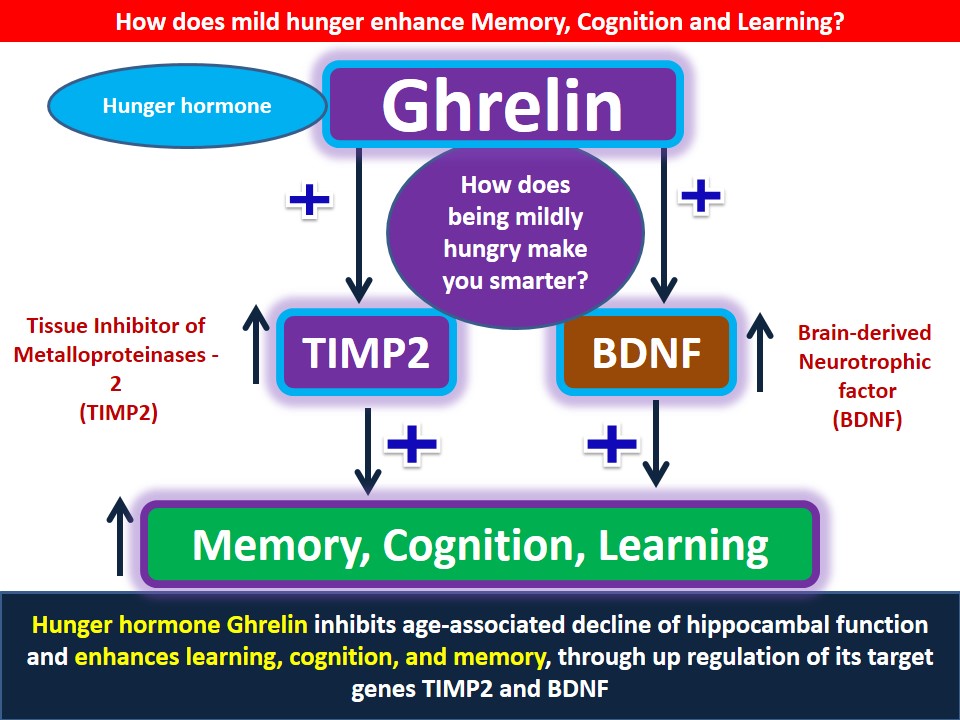
Empty-stomach intelligence is explained: Mechanistic insights into how hunger hormone Ghrelin augments augments memory, learning, and cognition:  Ghrelin, a digestive hormone that controls appetite,  increases Tissue inhibitor of metalloproteinases 2 (TIMP2) and BDNF levels, improves cognition, and attenuates age-associated decline in memory and learning, via up-regulation of its target genes, 28/April/2018, 12.17 am

Empty-stomach intelligence is explained: Mechanistic insights into how hunger hormone Ghrelin augments augments memory, learning, and cognition:  Ghrelin, a digestive hormone that controls appetite,  increases Tissue inhibitor of metalloproteinases 2 (TIMP2) and BDNF levels, improves cognition, and attenuates age-associated decline in memory and learning, via up-regulation of its target genes, 28/April/2018, 12.17 am 960 720 Dr Boomi's Genom-2-Discovery Center

Introduction: What they say A study from Department of Neurology and Neurological Sciences, Stanford University School of Medicine, Stanford, California 94305, USA;  Paul F. Glenn Center for the Biology of…

read more

Starve yourself a little to stay sharper during exams: Mechanistic insights into how caloric restriction augments augments memory, learning, and cognition:  Caloric restriction increases Tissue inhibitor of metalloproteinases 2 (TIMP2) and BDNF levels, improves cognition, and attenuates age-associated decline in memory and learning, via up-regulation of its target genes, 25/April/2018, 7.43 am

Starve yourself a little to stay sharper during exams: Mechanistic insights into how caloric restriction augments augments memory, learning, and cognition:  Caloric restriction increases Tissue inhibitor of metalloproteinases 2 (TIMP2) and BDNF levels, improves cognition, and attenuates age-associated decline in memory and learning, via up-regulation of its target genes, 25/April/2018, 7.43 am 960 720 Dr Boomi's Genom-2-Discovery Center

Introduction: What they say A study from Department of Neurology and Neurological Sciences, Stanford University School of Medicine, Stanford, California 94305, USA;  Paul F. Glenn Center for the Biology of…

read more

Embryo-derived peptide augments memory, learning, and cognition: Synthetic PreImplantation Factor (sPIF), a peptide derived from embryos, increases Tissue inhibitor of metalloproteinases 2 (TIMP2) and BDNF levels, improves cognition, and attenuates age-associated decline in memory and learning, via up-regulation of its target genes, 25/April/2018, 6.31 am

Embryo-derived peptide augments memory, learning, and cognition: Synthetic PreImplantation Factor (sPIF), a peptide derived from embryos, increases Tissue inhibitor of metalloproteinases 2 (TIMP2) and BDNF levels, improves cognition, and attenuates age-associated decline in memory and learning, via up-regulation of its target genes, 25/April/2018, 6.31 am 960 720 Dr Boomi's Genom-2-Discovery Center

Introduction: What they say A study from Department of Neurology and Neurological Sciences, Stanford University School of Medicine, Stanford, California 94305, USA;  Paul F. Glenn Center for the Biology of…

read more