

From Significance of the study to Public health relevance:
Given that: (i) each year nearly 14 million people are diagnosed with cancer globally, and little more than half of them will die; (ii) cancer deaths globally are expected to be doubled by 2030; (iii) most of the cancer patients die due to metastasis; (iv) cancer treatment causes the highest economic loss compared to all the known causes of death worldwide, there is an urgent need to find: (i) bio-molecules that drive metastatic process; and the the way to prevent their expression; (ii) a way to activate immune system to combat cancer (Cancer immunotherapy); (ii) a cheaper alternative to the existing expensive anticancer drugs; (ii) a side-effect-free natural product-based drug; (iii) increase the therapeutic index of anticancer drugs; and (iv) a way to effectively treat and prevent metastatic progression and relapse of advanced/drug-resistant cancers.
Research findings to Therapeutic opportunity:
A number of studies suggests that natural-product derived compound Solasodine inhibits tumor cell proliferation. However, the mechanism of action is far from clear.
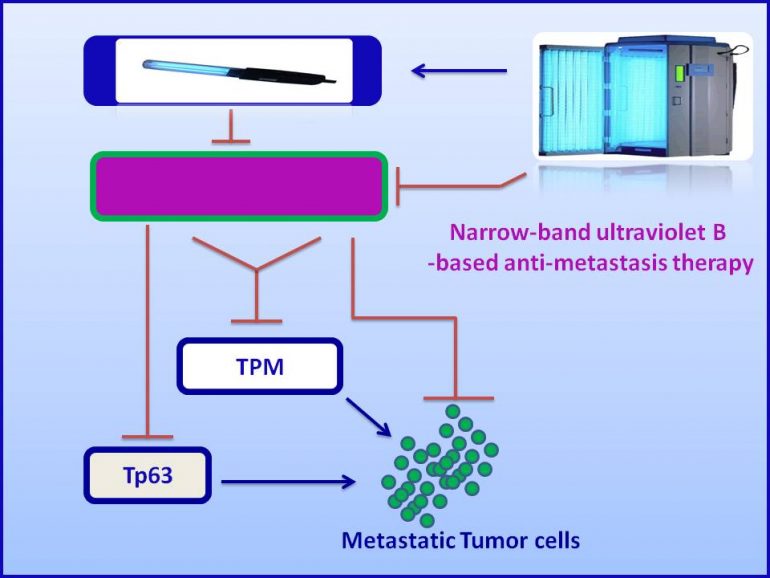
This study suggests that Narrow-band ultraviolet B, by regulating the expression of its target genes, it may increase the expression of metastasis suppressors TPM1 (Tropomyosin 1) and Tp63 (fig. 1).

[easy_payment currency=”USD”]
Thereby, it may: (a) inhibit cell cycle progression; and (d) suppress migration, invasion and metastasis of cancer cells.
Thus, Narrow-band ultraviolet B-based therapy may be advised for metastatic cancer patients to (i) increase the expression of metastasis suppressor genes; (ii) inhibit the progression of metastatic tumors; and (ii) enhance the efficacy of Cancer therapy. Together, oncologists may consider adopting Narrow-band ultraviolet B-based therapy in the treatment of Cancer.
Details of the research findings:
Idea Proposed/Formulated (with experimental evidence) by:
Dr L Boominathan Ph.D.
Amount: $10
Undisclosed mechanistic information: How Narrow-band ultraviolet B increases the expression of metastasis suppressors TPM1 (Tropomyosin 1) and Tp63

Fig1. Mechanistic insights into how Narrow-band ultraviolet B functions as an anti-metastasis agent. Narrow-band ultraviolet B increases the expression of metastasis suppressors TPM1 and Tp63 via down regulation of its target genes.
Terms & Conditions apply http://genomediscovery.org/registration/terms-and-conditions/
For purchase and payment details, you may reach us at info@genomediscovery.org
References:
Citation: Boominathan, L., Narrow-band ultraviolet B therapy for Metastatic cancers: Narrow-band ultraviolet B increases the expression of metastasis promoters TPM1 (Tropomyosin 1) and Tp63, inhibits cell cycle progression, and suppresses migration, invasion and metastasis of cancer cells via up regulation of its target gene, 31/May/2017, 11.01 pm, Genome-2-Bio-Medicine Discovery center (GBMD), http://genomediscovery.org
Web: http://genomediscovery.org or newbioideas.com/
Courtesy: When you cite drop us a line at info@genomediscovery.org