


Introduction: What they say:
A study from the Division of Experimental Hematology, Cincinnati Children’s Hospital Medical Center, Cincinnati, Ohio, USA; Division of Pathology, Cincinnati Children’s Hospital Medical Center, Cincinnati, Ohio, USA shows that inhibition of c-FOS and DUSP1 abrogates intrinsic resistance to tyrosine-kinase inhibitor therapy in BCR-ABL-induced leukemia. This study was published in the 20 March 2017 issue of the journal “Nature Medicine” [One of the best journals in General Medicine with an I.F of 30.357 plus] by Prof. Mohammad, Meenu Kesarwani, and others.
What we say:
On the foundation of this interesting finding, Dr L Boominathan PhD, Director-cum-chief Scientist of GBMD, reports that: Combination therapy for enhancing the efficacy of tyrosine-kinase inhibitor (TKI) in BCR-ABL-induced Human leukemia: A therapeutic mix encompassing Ascorbate and Forodesine decreases the expression of oncoproteins c-FOS, DUSP1 and BCR-ABL, inhibits TKI resistance, restores treatment responsiveness, increases therapeutic index of anticancer drugs, and cure CML and kinase-driven cancers via up-regulation of its target gene

From Significance of the study to Public health relevance:
Given that: (i) each year nearly 14 million people are diagnosed with cancer globally, and little more than half of them will die; (ii) cancer deaths globally are expected to be doubled by next decade or so; (iii) cancer treatment causes the highest economic loss compared to all the known causes of death worldwide; (iv) Acute myeloid leukemia (AML) is one of the most predominant leukemias among all adult leukemias, while Chronic myeloid leukemia (CML) accounts for about only 10% of all leukemias; (v) each year about 10,500 and 2900 new cases of AML are reported in the US and the UK, respectively; (vi) cure rates of AML ranges from 20-45% only, there is an urgent need to find: (i) a way to activate patient’s immune system (Cancer immunotherapy); (ii) a cheaper alternative to the existing expensive anticancer drugs; (ii) a side-effect-free natural product-based drug; and (iii) a way to effectively treat and prevent metastatic progression and relapse of cancers.
What is known:
It has recently shown that: (1) growth factor signalling, mediated by oncoprotein c-fos (FBJ osteosarcoma oncogene) and DUSP1 (dual-specificity phosphatase 1), promotes Tyrosine kinase inhibitor resistance in a number of leukemias, including kinase-driven leukemias; (2) deletion of oncoprotein c-FOS and DUSP1 inhibits CML progression in a BCR-ABL fusion protein kinase–induced mouse model of CML; (3) combined inhibition of c-FOS, DUSP1 and BCR-ABL completely eradicated the tumor cells that cause relapse and drug resistance in a number of mouse models, suggesting that inhibition of oncoproteins c-FOS and DUSP1 may enhance TKI efficacy in treatment-resistant CML and in other kinase-driven leukemias.
From research findings to therapeutic opportunity :
This study suggests a combination therapy for enhancing the efficacy of tyrosine-kinase inhibitor therapy in BCR-ABL-induced Human leukemia.
Both Vitamin-c/Ascorbate and Forodesine have been shown to known to function as an anticancer agent (fig. 1). However, the detailed mechanistic insights is yet to emerge.
A therapeutic mix encompassing Vitamin-c/Ascorbate and Forodesine, by increasing the expression of its target genes, it may decrease the expression of c-FOS, DUSP1 and BCR-ABL (fig. 1). Thereby, it may: (i) inhibit growth factor signalling that promote TKI resistance; (ii) eradicate the tumor/cancer stem cells that cause relapse; (iii) eradicate minimal residual disease (MRD); (iv) restore anti-cancer treatment responsiveness; (v) increase therapeutic index of anticancer drugs; (vi) eradicate CML; and (vii) cure CML (fig.1).
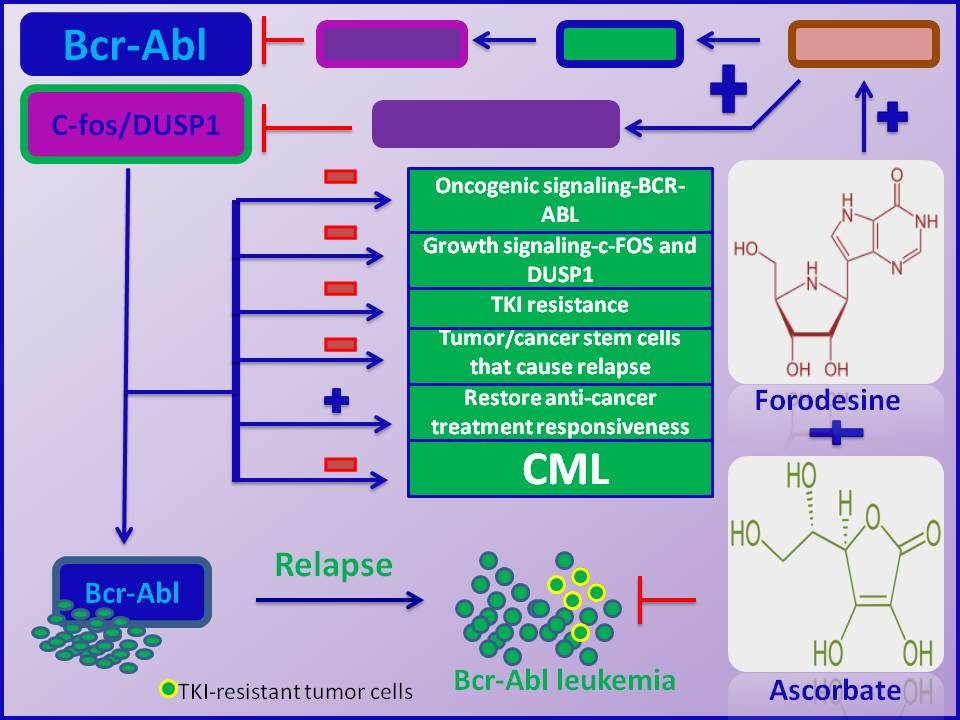
Figure 1. Mechanistic insights into how a therapeutic mix encompassing Vitamin-c and Forodesine suppresses the expression of c-FOS, DUSP1 and BCR-ABL to restore treatment responsiveness in CML cells.
Thus, pharmacological formulations encompassing “Vitamin-c and Forodesine A or their analogues, either alone or in combination with other known TKI drugs” may be used to inhibit CML growth.
[easy_payment currency=”USD”]
Details of the Research findings:
Idea Proposed/Formulated (with experimental evidence) by: Dr L Boominathan Ph.D.
Amount: $500#
Undisclosed mechanistic information: How does a therapeutic mix encompassing Vitamin-c and Forodesine decrease the expression of c-FOS, DUSP1 and BCR-ABL to inhibit CML growth?
Terms & Conditions apply http://genomediscovery.org/registration/terms-and-conditions/
For purchase and payment details, you may reach us at info@genomediscovery.org
#Research cooperation
References:
Web: http://genomediscovery.org or http://newbioideas.com/
Citation: Boominathan, L., Combination therapy for enhancing the efficacy of tyrosine-kinase inhibitor (TKI) in BCR-ABL-induced Human leukemia: A therapeutic mix encompassing Ascorbate and Forodesine decreases the expression of oncoproteins c-FOS, DUSP1 and BCR-ABL, inhibits TKI resistance, restores treatment responsiveness, increases therapeutic index of anticancer drugs, and cure CML and kinase-driven cancers via up-regulation of its target gene, 16/June/2017, 2.05 am, Genome-2-Bio-Medicine Discovery center (GBMD), http://genomediscovery.org
Courtesy: When you cite, Kindly drop us a line at admin@genomediscovery.org