

Introduction: What they say:
A study from the State Key Laboratory of Cellular Stress Biology, Innovation Center for Cell Signaling Network, School of Life Sciences, Xiamen University, Xiamen, Fujian 361102, China shows that “c-Src phosphorylation and activation of hexokinase promotes tumorigenesis and metastasis.” This study was published in the 5 January 2017 issue of the journal “Nature communications” [one of the best journals in General Biology with an I.F of 11.329 plus] by Prof. Li Qinxi, Jia Zhang, and others.
What we say:
On the foundation of this interesting finding, Dr L Boominathan PhD, Director-cum-chief Scientist of GBMD, reports that: Natural product-derived therapy for Metastatic human tumors: A therapeutic mix encompassing Ivermectin and Curcumin decreases the expression of c-SRC protein, inhibits the expression of a number of enzymes of glycolysis, and suppresses proliferation, migration, invasion, tumorigenesis and metastasis via up regulation of its target gene
From Significance of the study to Public health relevance:
Given that: (i) each year nearly 14 million people globally are diagnosed with cancer, and a little more than half of them will die; (ii) cancer deaths globally are expected to be doubled by 2030; (iii) cancer treatment causes the highest economic loss compared to all the known causes of death worldwide, there is an urgent need to find: (i) a way to prevent an individual from being susceptible to cancer by strengthening his/her own immune system; (ii) a cheaper alternative to the existing expensive anticancer drugs; (ii) a side-effect-free natural product-based drug; and (iii) a way to effectively treat and prevent metastatic progression and relapse of cancers.
What we infer from what they say:
Prof. Li Qinsi’s research team has recently shown that oncoprotein c-Src: (1) phosphorylates the rate limiting enzyme of the glycolysis Hexokinase-1/2 (HK1)/(HK2) at Tyr732; (2) prevents HK dimer formation; (3) increases affinity (decreases Km value for glucose) for glucose; and (4) promotes tumor survival even under poor glucose conditions. Further, they shown that HK1-Y732 phosphorylation level correlates with metastasis capability of primary cancers. Together, these findings suggest that inhibition of c-Src and its down stream target Hexokinase expression in cancer cells may prevent tumor growth.
From research findings to therapeutic opportunity :
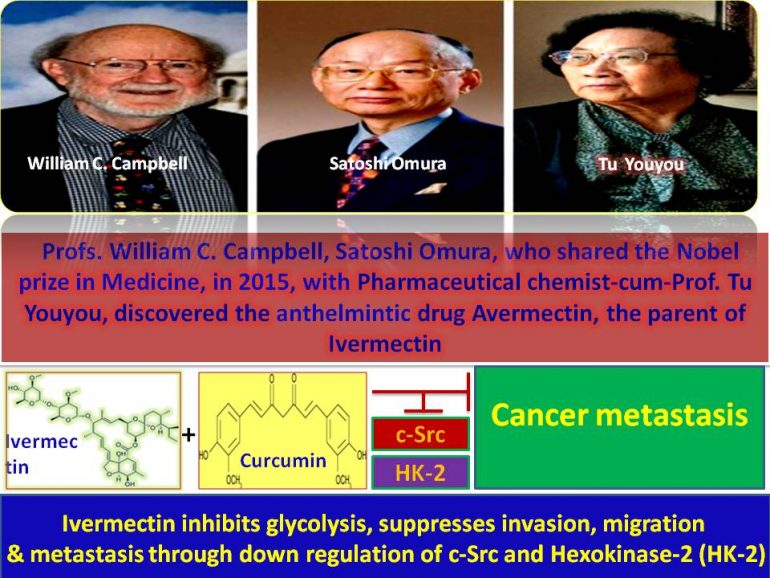
This study suggests a natural product-derived combinatorial therapy for cancer. Ivermectin and Curcumin have been shown to function as an anticancer agent (fig. 1). However, the detailed mechanistic insights is yet to emerge.
A therapeutic mix encompassing Ivermectin and Curcumin, by increasing the expression of its target genes, it may decrease the expression of c-Src and HK-1/2 (fig. 1). Thereby, it may: (i) augment HK dimer formation; (ii) increase Km value for glucose; (iii) decrease tumor survival; (iv) inhibit tumor proliferation and growth; and (v) promote tumor regression (fig.1).
 [easy_payment currency=”USD”]
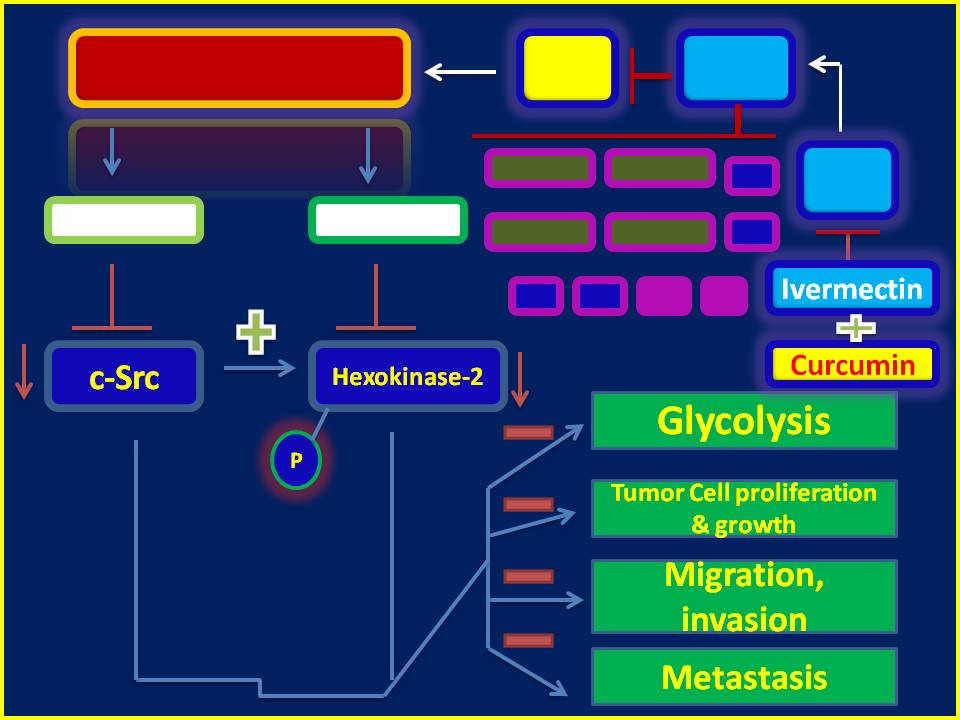
Figure 1. Mechanistic insights into how a therapeutic mix encompassing Ivermectin and Curcumin suppresses the expression of c-Src and Hexokinase- 1/2 to promote tumor regression.
Thus, pharmacological formulations encompassing “Ivermectin and Curcumin or their analogues either alone or in combination with other known anticancer drugs” (fig. 2) may be used to inhibit metastatic progression of primary cancers.
Details of the Research findings:
Idea Proposed/Formulated (with experimental evidence) by: Dr L Boominathan Ph.D.
Amount: $500#
Undisclosed mechanistic information: How does Eriocitrin decrease the expression of c-Src and HK1/2 to inhibit tumor growth?
Terms & Conditions apply http://genomediscovery.org/registration/terms-and-conditions/
For purchase and payment details, you may reach us at info@genomediscovery.org
#Research cooperation
References:
Web: http://genomediscovery.org or http://newbioideas.com/
Citation: Boominathan, L., Natural product-derived therapy for Metastatic human tumors: A therapeutic mix encompassing Ivermectin and Curcumin decreases the expression of c-SRC protein, inhibits the expression of a number of enzymes of glycolysis, and suppresses proliferation, migration, invasion, tumorigenesis and metastasis via up regulation of its target gene, 28/August/2017, 12.31 am, Genome-2-Bio-Medicine Discovery center (GBMD), http://genomediscovery.org
Courtesy: When you cite, Kindly drop us a line at admin @genomediscovery.org