Diabetes

Lighting your way to treat blood sugar disease: Blue light-based therapy for diabetes (TIIDM): Intense blue light increases GLP1R and Caveolin-1 (CAV-1) expression, promotes glucose-induced insulin secretion, improves insulin sensitivity, increases energy utilization, promotes weight loss and protects from diet-induced obesity and TIIDM, via up regulation of its target gene, 29/April/2018, 7.29 am

Lighting your way to treat blood sugar disease: Blue light-based therapy for diabetes (TIIDM): Intense blue light increases GLP1R and Caveolin-1 (CAV-1) expression, promotes glucose-induced insulin secretion, improves insulin sensitivity, increases energy utilization, promotes weight loss and protects from diet-induced obesity and TIIDM, via up regulation of its target gene, 29/April/2018, 7.29 am 960 720 Dr Boomi's Genom-2-Discovery Center

Introduction: What they say A study from the Comprehensive Diabetes Center and Department of Medicine, Division of Endocrinology, Diabetes, and Metabolism, University of Alabama at Birmingham, Birmingham, AL shows that “miR-204 Controls…

read more

Blue light-based therapy for TIIDM and obesity-associated metabolic deficits: Intense blue light therapy increases Lipocalin 2 (LCN2) expression, activates an MC4R-dependent anorexigenic pathway, suppresses appetite and weight gain, increases insulin secretion, improves glucose tolerance, promotes glucose homeostasis, improves obesity-associated metabolic deficits and prevents progression to TIIDM via down regulation of its target gene, 27/April/2018, 11.32 pm

Blue light-based therapy for TIIDM and obesity-associated metabolic deficits: Intense blue light therapy increases Lipocalin 2 (LCN2) expression, activates an MC4R-dependent anorexigenic pathway, suppresses appetite and weight gain, increases insulin secretion, improves glucose tolerance, promotes glucose homeostasis, improves obesity-associated metabolic deficits and prevents progression to TIIDM via down regulation of its target gene, 27/April/2018, 11.32 pm 960 720 Dr Boomi's Genom-2-Discovery Center

Introduction: What they say A study from the Department of Physiology-Cellular Biophysics, College of Physicians and Surgeons, Columbia University, New York, New York, USA shows that “MC4R-dependent suppression of appetite by…

read more

Blue light-based therapy for body weight control, energy homeostasis and TIIDM: Blue light therapy decreases CADM1 and its downstream target genes that inhibit glucose-induced insulin secretion, improves insulin sensitivity, increases energy utilization, promotes weight loss and protects from diet-induced obesity and TIIDM, via up regulation of its target gene, 24/April/2018, 11.49 am

Blue light-based therapy for body weight control, energy homeostasis and TIIDM: Blue light therapy decreases CADM1 and its downstream target genes that inhibit glucose-induced insulin secretion, improves insulin sensitivity, increases energy utilization, promotes weight loss and protects from diet-induced obesity and TIIDM, via up regulation of its target gene, 24/April/2018, 11.49 am 960 720 Dr Boomi's Genom-2-Discovery Center

Introduction: What they say A study from the Max Delbrück Center for Molecular Medicine, Berlin, Germany shows that “Regulation of body weight and energy homeostasis by neuronal cell adhesion molecule1.” This research paper…

read more

Treating blood sugar disease with antidepressants: Duloxetine-based therapy for diabetes (TIIDM): Duloxetine (Brand name: Cymbalta), used in the treatment of major depressive disorder, generalized anxiety disorder, fibromyalgia, neuropathic pain and others, increases GLP1R and Caveolin-1 (CAV-1) expression, promotes glucose-induced insulin secretion, improves insulin sensitivity, increases energy utilization, promotes weight loss and protects from diet-induced obesity and TIIDM, via up regulation of its target gene, 18/April/2018, 9.49 pm

Treating blood sugar disease with antidepressants: Duloxetine-based therapy for diabetes (TIIDM): Duloxetine (Brand name: Cymbalta), used in the treatment of major depressive disorder, generalized anxiety disorder, fibromyalgia, neuropathic pain and others, increases GLP1R and Caveolin-1 (CAV-1) expression, promotes glucose-induced insulin secretion, improves insulin sensitivity, increases energy utilization, promotes weight loss and protects from diet-induced obesity and TIIDM, via up regulation of its target gene, 18/April/2018, 9.49 pm 960 720 Dr Boomi's Genom-2-Discovery Center

Introduction: What they say A study from the Comprehensive Diabetes Center and Department of Medicine, Division of Endocrinology, Diabetes, and Metabolism, University of Alabama at Birmingham, Birmingham, AL shows that…

read more

Neurotensin-based therapy for body weight control, energy homeostasis and TIIDM: Neurotensin, a 13-amino acid neuropeptide known to play a role in thermoregulation and neuroprotection, decreases CADM1 and its downstream target genes that inhibit glucose-induced insulin secretion, improves insulin sensitivity, increases energy utilization, promotes weight loss and protects from diet-induced obesity and TIIDM, via up regulation of its target gene, 17/April/2017, 2.09 pm

Neurotensin-based therapy for body weight control, energy homeostasis and TIIDM: Neurotensin, a 13-amino acid neuropeptide known to play a role in thermoregulation and neuroprotection, decreases CADM1 and its downstream target genes that inhibit glucose-induced insulin secretion, improves insulin sensitivity, increases energy utilization, promotes weight loss and protects from diet-induced obesity and TIIDM, via up regulation of its target gene, 17/April/2017, 2.09 pm 960 720 Dr Boomi's Genom-2-Discovery Center

Introduction: What they say A study from the Max Delbrück Center for Molecular Medicine, Berlin, Germany shows that “Regulation of body weight and energy homeostasis by neuronal cell adhesion molecule1.”…

read more

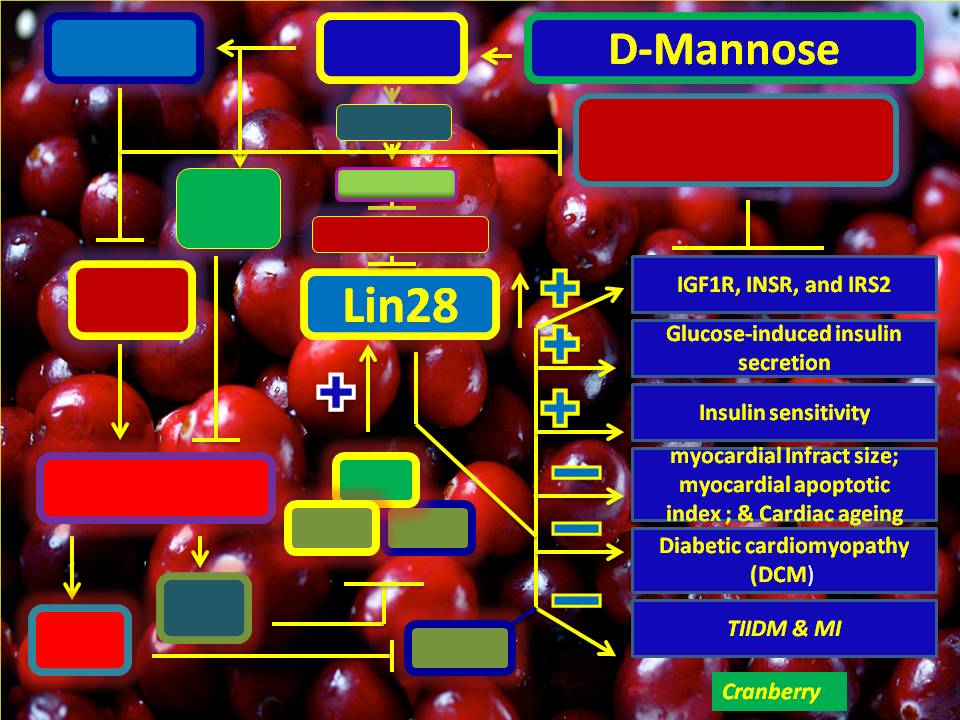
A sweet way to say no to blood sugar disease: Sugar-based therapy for TIIDM: D-Mannose, a C-2 epimer of glucose,  increases the expression of IGF1R, INSR, and IRS2, and promotes an insulin-sensitized state, via up-regulation of  its target gene Lin28, 14/April/2018, 11.28 pm

A sweet way to say no to blood sugar disease: Sugar-based therapy for TIIDM: D-Mannose, a C-2 epimer of glucose,  increases the expression of IGF1R, INSR, and IRS2, and promotes an insulin-sensitized state, via up-regulation of  its target gene Lin28, 14/April/2018, 11.28 pm 960 720 Dr Boomi's Genom-2-Discovery Center

Introduction: What they say:   A study from the Stem Cell Transplantation Program, Division of Pediatric Hematology/Oncology, Boston Children’s Hospital and Dana-Farber Cancer Institute, Boston, Massachusetts, USA shows that “The Lin28/let-7 axis regulates glucose metabolism.” This study…

read more