


Introduction: What they say
A study from the Laboratory of Obesity and Aging Research, National Heart Lung and Blood Institute, National Institutes of Health, Bethesda, MD 20892, USA; and Laboratory of Obesity and Aging Research, National Heart Lung and Blood Institute, National Institutes of Health, Bethesda, MD 20892, USA shows that “DNA-PK Promotes the Mitochondrial, Metabolic, and Physical Decline that Occurs During Aging.” This research paper was published, in the 2 May 2017 issue of the journal “Cell Metabolism” [One of the best research journals in Metabolism research with an I.F of 17.303], by Prof. Chung JH and Park SJ and others.
What we say:
On the foundation of this interesting finding, Dr L Boominathan PhD, Director-cum-chief Scientist of GBMD, reports that: Molecular therapy for middle aged TIIDM patients: Fidarestat, an alodose reductase inhibitor used to control diabetic complications, decreases DNA-PPK expression, suppresses phosphorylation of HSP90a, increases AMPK activity, augments mitochondrial biogenesis and energy metabolism, promotes weight loss and exercise endurance and alleviates TIIDM via down regulation of its target gene

Significance of the study:
Given that: (1) more than 387 million people worldwide are affected by Diabetes mellitus (DM); (2) Diabetes is going to be one of the top 10 causes of death by 2030; (3) the life-long painful injection/drug treatment is required to treat DM; (3) the global economic cost spent for diabetes treatment in 2014 was little more than 600 billion US dollars, there is an urgent need to find: (i) a way to induce regeneration of adult ß-cells that were lost in DM; (ii) a cheaper alternative to the existing expensive weight-loss drugs; (iii) a side-effect-free natural product-based drug; and (iv) a way to cure, not just treat, diabetes.
What is known?
Prof. Chung JH’s research team has recently shown that as ageing increases DNA breaks occur more frequently and activation of DNA-dependent protein kinase (DNA-PK) occur which results in:(1) decreased mitochondrial function, metabolism and physical fitness; (2) increased phosphorylation of HSP90a; (3) decreased chaperone function toward its client protein such as AMP-activated protein kinase (AMPK); and (4) compromised mitochondrial biogenesis and energy metabolism. Conversely, decreasing DNA-PK results in: (1) increased AMPK activity; (2) weight loss; and (3) protection against TIIDM, suggesting that decreasing the expression of DNA-PK in in middle aged diabetic patients may alleviate TIIDM and increase exercise endurance.
From Research findings to Therapeutic opportunity:
This study provides mechanistic insights into how Fidarestat may aid in the treatment of TIIDM.
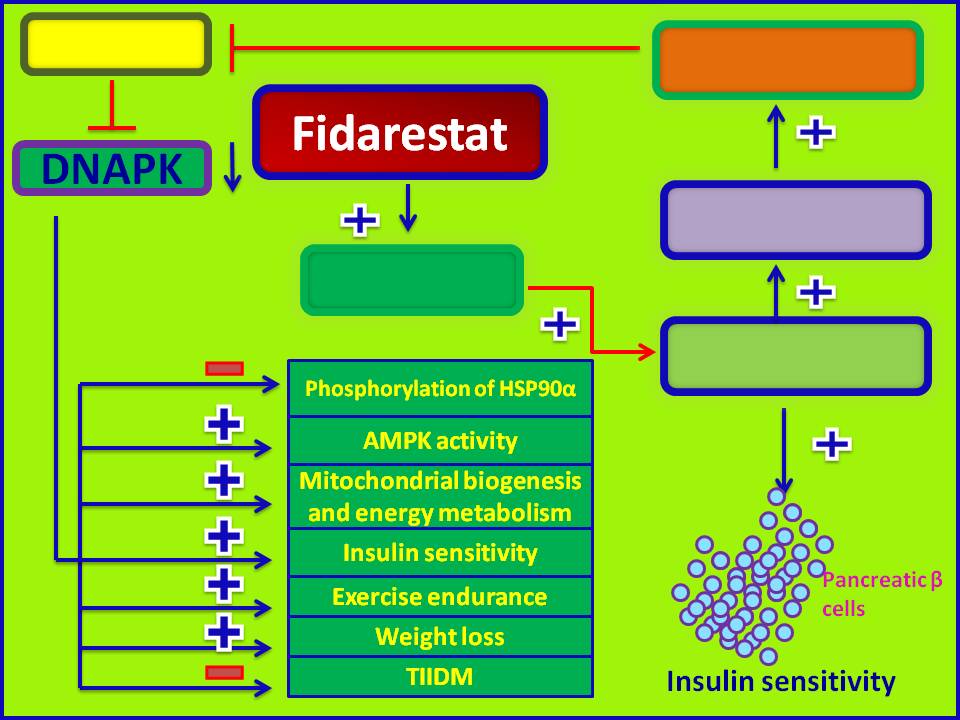
Figure 1. Mechanistic insight into how Fidarestat inhibits DNAPK expression, promotes insulin sensitivity and alleviates TIIDM
Fidarestat, by increasing the expression of its target gene, it may decrease the expression of DNA-PK. Thereby, it may: (1) decrease phosphorylation of HSP90a; (2) increase AMPK activity; (3) increase mitochondrial biogenesis and energy metabolism; (4) increase insulin sensitivity; (5) increase exercise endurance; (6) augment weight loss; and (7) protect against TIIDM (Fig.1).
Thus, pharmacological formulations encompassing “Fidarestat or its analogues, either alone or in combination with other drugs,” may be used to treat middle-aged Obese TIIDM patients.
[easy_payment currency=”USD”]
Details of the research findings:
Idea Proposed/Formulated (with experimental evidence) by: Dr L Boominathan Ph.D.
Terms & Conditions apply http://genomediscovery.org/registration/terms-and-conditions/
Undisclosed mechanistic information: How does Fidarestat decrease the expression of DNAPK to promote insulin sensitivity?
Amount: $500#
# Research cooperation
For purchase and payment details, you may reach us at info@genomediscovery.org
References:
Web: http://genomediscovery.org or http://newbioideas.com
Citation: Boominathan, L., Molecular therapy for middle aged TIIDM patients: Fidarestat, an alodose reductase inhibitor used to control diabetic complications, decreases DNA-PPK expression, suppresses phosphorylation of HSP90a, increases AMPK activity, augments mitochondrial biogenesis and energy metabolism, promotes weight loss and exercise endurance and alleviates TIIDM via down regulation of its target gene, 15/November/2017, 5.26 am, Genome-2-Bio-Medicine Discovery center (GBMD), http://genomediscovery.org