Ideas

Vitamin-based therapy for body weight control, energy homeostasis and TIIDM:  A therapeutic mix encompassing  Vitamin-B12 and Omega-3 fatty acids decreases CADM1 and its downstream target genes that promote glucose-induced insulin secretion, improves insulin sensitivity, increases energy utilization, promotes weight loss and protects from diet-induced obesity and TIIDM via up regulation of its target gene, 14/December/2017, 12.55 am

Vitamin-based therapy for body weight control, energy homeostasis and TIIDM:  A therapeutic mix encompassing  Vitamin-B12 and Omega-3 fatty acids decreases CADM1 and its downstream target genes that promote glucose-induced insulin secretion, improves insulin sensitivity, increases energy utilization, promotes weight loss and protects from diet-induced obesity and TIIDM via up regulation of its target gene, 14/December/2017, 12.55 am 960 720 Dr Boomi's Genom-2-Discovery Center

Introduction: What they say A study from the Max Delbrück Center for Molecular Medicine, Berlin, Germany shows that “Regulation of body weight and energy homeostasis by neuronal cell adhesion molecule1.”…

read more
Regenerative therapy for regaining the lost cardiomyocytes in Myocardial patients:  A pharmaceutical mixture [TMZATX] encompassing Trimetazidine (TMZ) and Astaxanthin (ATX)  increases the expression of ERBB2/Her2 and promotes dedifferentiation  of cardiomyocytes via down regulation of its target gene, 14/December/2017, 12.14 am

Regenerative therapy for regaining the lost cardiomyocytes in Myocardial patients:  A pharmaceutical mixture [TMZATX] encompassing Trimetazidine (TMZ) and Astaxanthin (ATX)  increases the expression of ERBB2/Her2 and promotes dedifferentiation  of cardiomyocytes via down regulation of its target gene, 14/December/2017, 12.14 am 960 720 Dr Boomi's Genom-2-Discovery Center

Introduction: What they say A recent study from the Department of Biological Regulation, Weizmann Institute of Science, Rehovot 76100, Israel shows that “ERBB2 triggers mammalian heart regeneration by promoting cardiomyocyte dedifferentiation and proliferation.” This study was published, in the 6 April…

read more

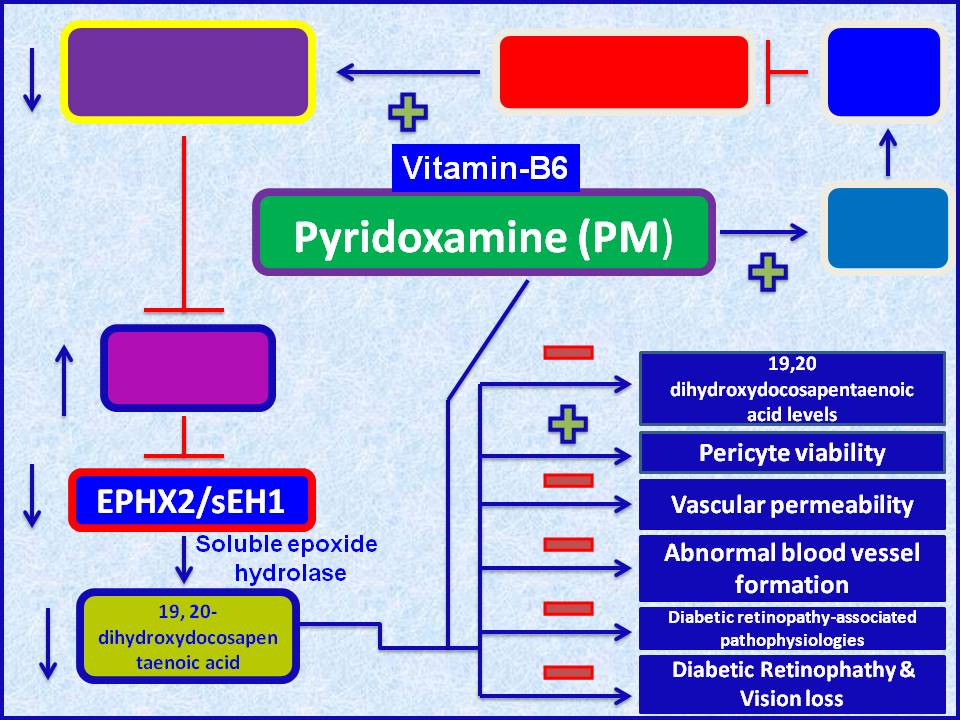
Vitamin-based therapy for Diabetic retinopathy: Pyridoxamine (PM), a form of Vitamin B6, inhibits Soluble epoxide hydrolase (sEH) expression, decreases toxic 19,20-dihydroxydocosapentaenoic acid levels, inhibits pericyte loss, vascular permeability, and inflammation of the eye and progression of diabetic retinopathy, via down regulation of its target gene, 13/December/2017, 1.07 am

Vitamin-based therapy for Diabetic retinopathy: Pyridoxamine (PM), a form of Vitamin B6, inhibits Soluble epoxide hydrolase (sEH) expression, decreases toxic 19,20-dihydroxydocosapentaenoic acid levels, inhibits pericyte loss, vascular permeability, and inflammation of the eye and progression of diabetic retinopathy, via down regulation of its target gene, 13/December/2017, 1.07 am 960 720 Dr Boomi's Genom-2-Discovery Center

Introduction: What they say A study from the Institute for Vascular Signalling, Centre for Molecular Medicine, Goethe University, Frankfurt am Main, Germany; and German Centre for Cardiovascular Research (DZHK) partner…

read more

Molecular therapy for Cardiomyopathy: A pharmacological mixture encompassing Trimetazidine (TMZ) and Astaxanthin (ATX) [TMZATX] decreases the expression of Sox6, restores the balance between slow- and fast-twitch myofiber proteins and alleviates Cardiomyopathy via up regulation of its target gene, 13/December/2017,  1.00 am

Molecular therapy for Cardiomyopathy: A pharmacological mixture encompassing Trimetazidine (TMZ) and Astaxanthin (ATX) [TMZATX] decreases the expression of Sox6, restores the balance between slow- and fast-twitch myofiber proteins and alleviates Cardiomyopathy via up regulation of its target gene, 13/December/2017,  1.00 am 960 720 Dr Boomi's Genom-2-Discovery Center

Introduction: What they say   A study from the Department of Cardiology, Boston Children’s Hospital, Harvard Medical School, Boston, Massachusetts, USA; and Harvard Stem Cell Institute, Harvard University, Cambridge, Massachusetts, USA shows that “Trbp regulates heart function through microRNA-mediated Sox6 repression.” This…

read more

Activation of the PD-1 pathway for Pain therapy: Trimetazidine (TMZ), used in the treatment of Angina Pectoris,  increases the expression of PD-L1, attenuates acutes and chronic pain, and suppresses mechanical and thermal hypersensitivity and inhibits nociceptive neuron excitability via up-regulation of its target gene, 13/December/2017, 12.23 am

Activation of the PD-1 pathway for Pain therapy: Trimetazidine (TMZ), used in the treatment of Angina Pectoris,  increases the expression of PD-L1, attenuates acutes and chronic pain, and suppresses mechanical and thermal hypersensitivity and inhibits nociceptive neuron excitability via up-regulation of its target gene, 13/December/2017, 12.23 am 960 720 Dr Boomi's Genom-2-Discovery Center

Introduction:What they say: A recent study, from Institute of Neurobiology, Institutes of Brain Science and State Key Laboratory of Medical Neurobiology, Collaborative Innovation Center for Brain Science, Fudan University, Shanghai,…

read more

Natural product-derived therapy for improving cardiac contractility and attenuating pathogenesis associated with Myocardial infarction: A pharmaceutical mixture encompassing Sulforaphane, Oleanolic acid, and Naringenin decreases GRK2 (G Protein-Coupled Receptor Kinase 2) and GM-CSF (Granulocyte-macrophage colony-stimulating factor) expression, increases cardiac contractility, inhibits undue leucocyte activation and invasion, suppresses recruitment of inflammatory cells, inhibits left ventricular rupture, promotes heart healing and inhibits glucose intolerance, via up regulation of its target gene, 13/December/2017, 12.12 pm

Natural product-derived therapy for improving cardiac contractility and attenuating pathogenesis associated with Myocardial infarction: A pharmaceutical mixture encompassing Sulforaphane, Oleanolic acid, and Naringenin decreases GRK2 (G Protein-Coupled Receptor Kinase 2) and GM-CSF (Granulocyte-macrophage colony-stimulating factor) expression, increases cardiac contractility, inhibits undue leucocyte activation and invasion, suppresses recruitment of inflammatory cells, inhibits left ventricular rupture, promotes heart healing and inhibits glucose intolerance, via up regulation of its target gene, 13/December/2017, 12.12 pm 960 720 Dr Boomi's Genom-2-Discovery Center

Introduction: What they say: A recent study, from Department of Medicine, Division of Cardiology, Dept of Cell Biology, and Department of Molecular Genetics, Duke University Medical Center, Durham, North Carolina,…

read more