Ideas

Ribonucleic acid-based therapy for Diabetes Mellitus: LncRNA-DC  augments the expression of FGF19 and FGF1,  attenuates hepatic glucose production, decreases hepatic acetyl CoA content, brings down the levels of plasma ACTH, and corticosterone, augments insulin sensitivity, promotes weight loss and alleviates TIDM via upregulation of its target gene, 25/February/2019, 1.03 am

Ribonucleic acid-based therapy for Diabetes Mellitus: LncRNA-DC  augments the expression of FGF19 and FGF1,  attenuates hepatic glucose production, decreases hepatic acetyl CoA content, brings down the levels of plasma ACTH, and corticosterone, augments insulin sensitivity, promotes weight loss and alleviates TIDM via upregulation of its target gene, 25/February/2019, 1.03 am 960 720 Dr Boomi's Genom-2-Discovery Center

Introduction: What they say  A study from Diabetes and Obesity Center of Excellence, Department of Medicine, University of Washington, Seattle, Washington, USA shows that Central injection of FGF1 induces sustained…

read more

Ribonucleic acid-based therapy for autoimmune diabetes (TIDM): LncRNA CACS15 increases PD-L1 expression, increases Tregs function, promotes immune tolerance, increases pancreatic β-cell proliferation and regeneration, increases insulin secretion, improves insulin sensitivity, increases energy utilization, and reverses TIDM, via up regulation of its target gene, 25/February/2019, 12.51 am

Ribonucleic acid-based therapy for autoimmune diabetes (TIDM): LncRNA CACS15 increases PD-L1 expression, increases Tregs function, promotes immune tolerance, increases pancreatic β-cell proliferation and regeneration, increases insulin secretion, improves insulin sensitivity, increases energy utilization, and reverses TIDM, via up regulation of its target gene, 25/February/2019, 12.51 am 960 720 Dr Boomi's Genom-2-Discovery Center

Introduction: What they say A study from the International Center for T1D, Pediatric Clinical Research Center Romeo ed Enrica Invernizzi, “L. Sacco” Department of Biomedical and Clinical Sciences, University of…

read more

Combinatorial therapy targeting PD-L1 pathway enhances the efficacy of Cancer immunotherapy in Glioblastoma: A therapeutic mix encompassing   Metformin, Navitoclax/ABT-263, Dasatinib and 2-Deoxy-d-glucose (MNDDG) inhibits oncoproteins EGFR, and Bcl-xl expression, increases tumor suppressor p53 expression, inhibits glioblastoma proliferation, increases interferon-IFNγ signalling, increase antigen presentation and unfolding response, increases Cytotoxic activity of T-cells, decreases tumor burden and increases survival, via up-regulation of its target gene, 25/February/2019, 12.17 pm

Combinatorial therapy targeting PD-L1 pathway enhances the efficacy of Cancer immunotherapy in Glioblastoma: A therapeutic mix encompassing   Metformin, Navitoclax/ABT-263, Dasatinib and 2-Deoxy-d-glucose (MNDDG) inhibits oncoproteins EGFR, and Bcl-xl expression, increases tumor suppressor p53 expression, inhibits glioblastoma proliferation, increases interferon-IFNγ signalling, increase antigen presentation and unfolding response, increases Cytotoxic activity of T-cells, decreases tumor burden and increases survival, via up-regulation of its target gene, 25/February/2019, 12.17 pm 960 720 Dr Boomi's Genom-2-Discovery Center

Introduction:What they say: A recent study from Department of Molecular and Medical Pharmacology, David Geffen UCLA School of Medicine, Los Angeles, California, USA; Jonsson Comprehensive Cancer Center, David Geffen UCLA…

read more

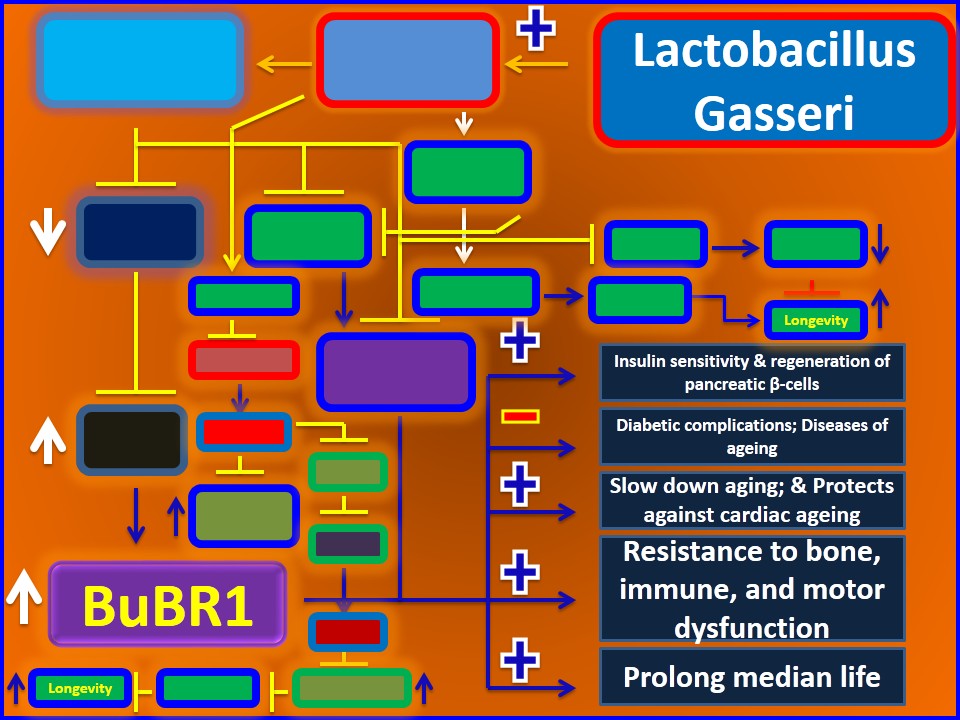
Probiotic Lactobascillus Gasseri functions as a longevity promoter: Lactobascillus Gasseri may  increase insulin sensitivity, slow down cardiac aging, and increase lifespan, via up-regulation of BubR1 and others genes, 24/February/2019, 11.58 pm

Probiotic Lactobascillus Gasseri functions as a longevity promoter: Lactobascillus Gasseri may  increase insulin sensitivity, slow down cardiac aging, and increase lifespan, via up-regulation of BubR1 and others genes, 24/February/2019, 11.58 pm 960 720 Dr Boomi's Genom-2-Discovery Center

 What they say: Introduction:  A recent study from the Department of Genetics, Paul F. Glenn Laboratories for the Biological Mechanisms of Aging Harvard Medical School, Boston, USA; and Department of Pharmacology,…

read more

Ribonucleic acid-based therapy for Diabetes Mellitus: LncRNA CCAT2  augments the expression of FGF19 and FGF1,  attenuates hepatic glucose production, decreases hepatic acetyl CoA content, brings down the levels of plasma ACTH, and corticosterone, augments insulin sensitivity, promotes weight loss and alleviates TIDM via upregulation of its target gene, 24/February/2019, 11.25 pm

Ribonucleic acid-based therapy for Diabetes Mellitus: LncRNA CCAT2  augments the expression of FGF19 and FGF1,  attenuates hepatic glucose production, decreases hepatic acetyl CoA content, brings down the levels of plasma ACTH, and corticosterone, augments insulin sensitivity, promotes weight loss and alleviates TIDM via upregulation of its target gene, 24/February/2019, 11.25 pm 960 720 Dr Boomi's Genom-2-Discovery Center

Introduction: What they say  A study from Diabetes and Obesity Center of Excellence, Department of Medicine, University of Washington, Seattle, Washington, USA shows that Central injection of FGF1 induces sustained…

read more
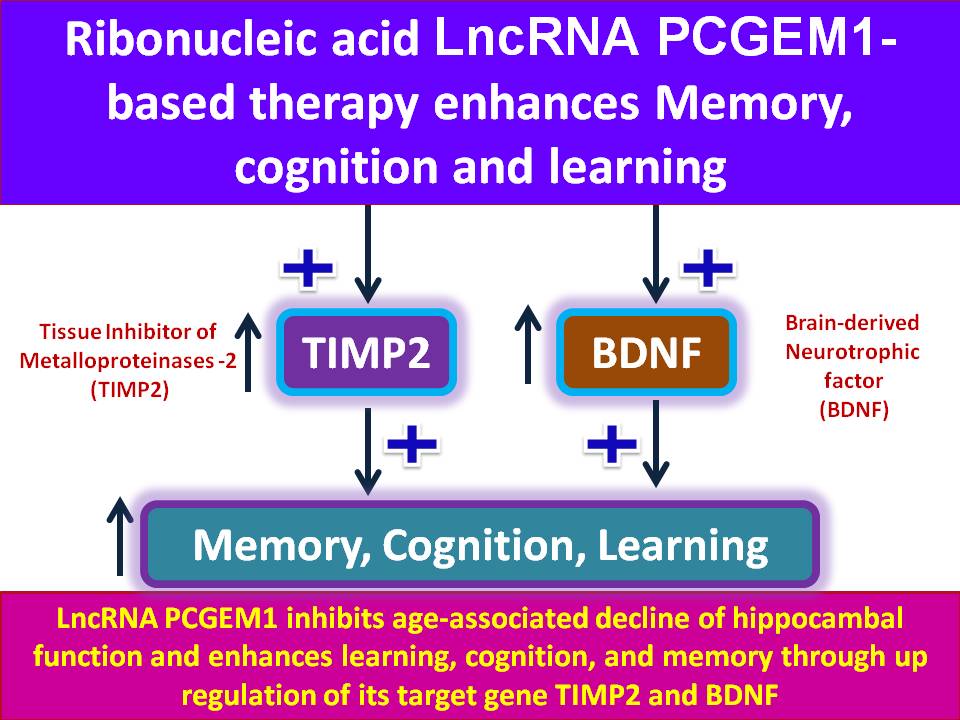
Ribonucleic acid-based therapy for enhancing memory and cognition: LncRNA PCGEM1 increases Tissue inhibitor of metalloproteinases 2 (TIMP2) levels, improves cognition, and decreases age-associated decline in memory and learning, via down-regulation of its target genes, 22/February/2019, 11.45 pm

Ribonucleic acid-based therapy for enhancing memory and cognition: LncRNA PCGEM1 increases Tissue inhibitor of metalloproteinases 2 (TIMP2) levels, improves cognition, and decreases age-associated decline in memory and learning, via down-regulation of its target genes, 22/February/2019, 11.45 pm 960 720 Dr Boomi's Genom-2-Discovery Center

Introduction: What they say: A study from Department of Neurology and Neurological Sciences, Stanford University School of Medicine, Stanford, California 94305, USA;  Paul F. Glenn Center for the Biology of…

read more