


Introduction:What they say:
A recent study from Cell Signalling Section, Division of Immunology, Department of Pathology, Tennis Court Road, University of Cambridge, Cambridge CB2 1QP, UK shows that “Glycogen Synthase Kinase 3 Inactivation Drives T-bet-Mediated Downregulation of Co-receptor PD-1 to Enhance CD8(+) Cytolytic T Cell Responses.” This study was published in the 16 February 2016 issue of Immunity (one of the best journals in Immunology with an impact factor of 20+) by Prof Rudd CE, Taylor A and others.
What we say:
On the foundation of this interesting finding, Dr L Boominathan PhD, Director-cum-chief Scientist of GBMD, reports that: Natural product-based PD-1 pathway blockade for Human cancer therapy: Dihydroartemisinin (DHA), a derivative of Artemisinin isolated from Artemisia Annua L, decreases the expression of Glycogen synthase kinase-3β, increases transcription factor T-bet expression, decreases the abundance of co-inhibitory receptor PD-1 on the cell surface of Cytotoxic-T-cells, increases cytotoxic T lymphocyte function and augments anti-tumor activity, via up-regulation of its target gene

What is known?
It has recently been shown that blocking PD-1 with antibodies one could make tumors shrink. This work, relating to Cancer immunotherapy, has been chosen as Science’s breakthrough of the year.
Research Findings:
This study suggests a Natural product-based Human cancer therapy.
The antimalarial drug Artemisinin, discovered by Chinese chemist Tu Youyu, for which she won Noble prize in 2015, has also been shown to function as an anti-cancer agent. However, the detailed mechanistic insights is yet to emerge.
A number of studies suggests that Dihydroartemisinin (DHA), a derivative of Artemisinin, inhibits tumor cell proliferation. However, the mechanism of action is far from clear.
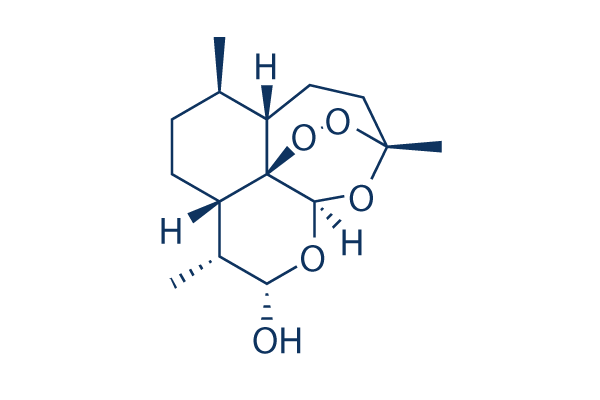
Figure 1. Dihydroartemisinin (DHA). DHA enhances cytolytic function of Cytotoxic T-lymphocytes, augments anti-tumor activity, and inhibits metastatic cancer progression via downregulation of Glycogen synthase kinase-3β and PD-1
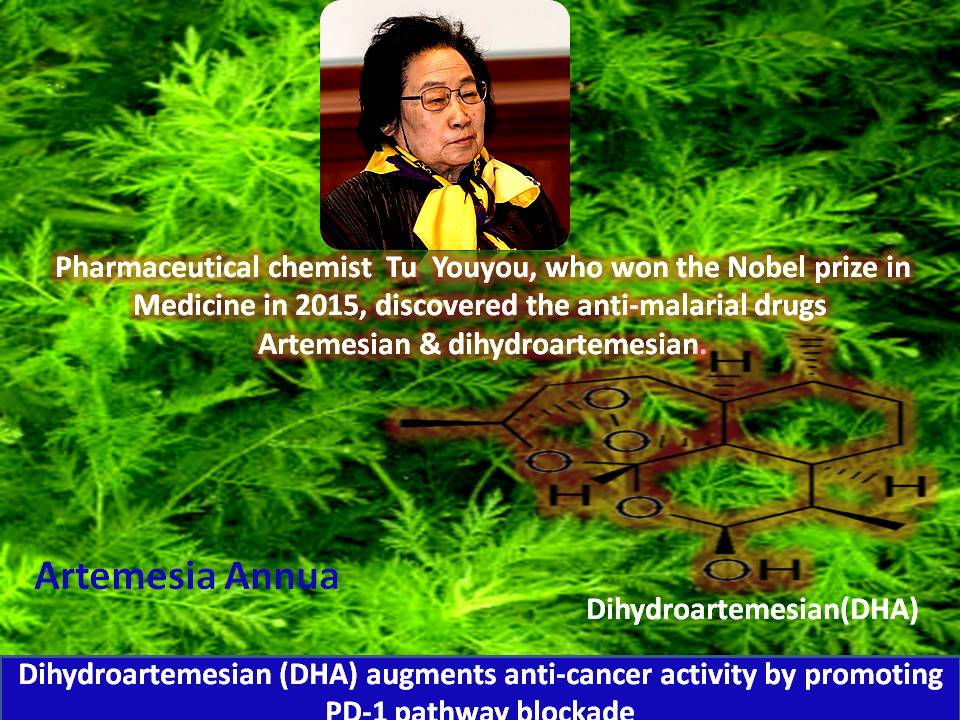
Figure 2. Dihydroartemesian (DHA)functions as an anticancer agent. Dihydroartemesian (DHA), isolated from Artemesia Annua L,, decreases the abundance of co-inhibitory receptor PD-1 on the cell surface of Cytotoxic-T-cells, increases cytotoxic T lymphocyte function and augments anti-tumor activity, via down regulation of Glycogen synthase kinase-3β
Dihydroartemisinin (DHA), by increasing the expression of its target gene, it may suppress the expression of Glycogen synthase kinase 3-β. Thereby, it may: (a) increase transcription factor T-bet expression; (b) inhibit co-inhibitory receptor PD-1 expression; (c) increase CD8(+) cytotoxic T lymphocyte function; (d) augment anti-tumor activity; & (e) inhibit metastatic cancer progression.
Therapeutic opportunity:
Thus, pharmacological formulations encompassing “Dihydroartemisinin (DHA) or its analogues, either alone or in combination with other drugs” may be used to inhibit the progression of tumors.
Details of the research findings:
Idea Proposed/Formulated (with experimental evidence) by: Dr L Boominathan Ph.D.
Terms & Conditions apply http://genomediscovery.org/registration/terms-and-conditions/
Amount: $50#
Undisclosed information: How Dihydroartemisinin (DHA) suppresses the expression of PD-1 and augments anti-tumor immunity
# Research cooperation
References:
Citation: Boominathan, L., Natural product-based PD-1 pathway blockade for Human cancer therapy: Dihydroartemisinin (DHA), a derivative of Artemisinin isolated from Artemisia Annua L, decreases the expression of Glycogen synthase kinase-3β, increases transcription factor T-bet expression, decreases the abundance of co-inhibitory receptor PD-1 on the cell surface of Cytotoxic-T-cells, increases cytotoxic T lymphocyte function and augments anti-tumor activity, via up-regulation of its target gene, 13 July, 2017, 10.05 pm, Genome-2-Bio-Medicine Discovery center (GBMD), http://genomediscovery.org
Web: http://genomediscovery.org or http://newbioideas.com
Courtesy: When you cite drop us a line at info@genomediscovery.org