


From Significance of the study to Public health relevance:
Given that: (1) Cancer suppressor p53 is mutated in more than 50% of human cancers of different tissue origin; (2) p53 pathway is altered in about 80% of tumors.; (3) our understanding is incomplete in terms of molecular targets and the oncogenic/malignant pathways involved in mutant p53-overexpressing tumors; and (4) cancer causes the highest economic loss compared to all the known causes of death worldwide, there is an urgent need to find: (i) a cheaper alternative to the existing expensive drugs; (ii) a side-effect-free natural product-based drug; and (iii) a way to effectively treat and stall metastatic progression and relapse of human cancers, including mutant p53-overexpressing cancers.
From therapeutic strategy to Research Findings:
(i) Therapeutic strategy:
This study suggests a therapeutic strategy for stalling the progression of p53-deficient/deleted or mutant-p53 expressing human metastatic cancers. That is, by: (1) activating tumor suppressor p53’s unmutated “homologous proteins such as TAp73 and TAp63” in p53-deficient or mutant-p53 expressing metastatic cancer cells; and (2) destabilizing mutant p53 expressed in cancer cells, one can inhibit their progression.
(ii) Research findings:
A number of studies suggests that Berberine, Gambogic acid, β-Cryptoxanthin (BCX) function as anticancer agents. However, the mechanism of action is far from clear. This study suggests, for the first time, that Berberine, Gambogic acid, β-Cryptoxanthin (BCX) [BGBCX), by increasing the expression of its target gene, it may not only increase the expression of tumor suppressors genes, such as p53, TAp73, TAp63, PTEN, INK4a etc., but also increase a number of metastatic suppressor genes, such as TPM1, TIMP3, BTG2, PDCD4, CCM1/KRIT1, SPRY1/2, RECK, etc. Thereby, it may inhibit the migration and invasion of metastatic cancer cells expressing mutant-p53 (figure1).
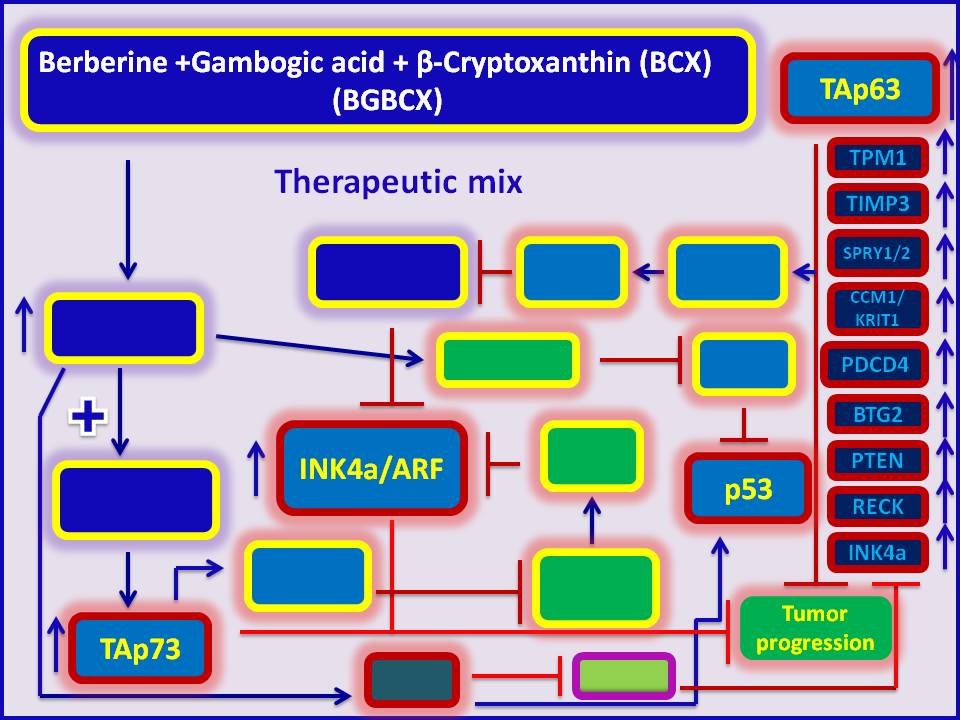
Figure 1. Mechanistic insight into how a therapeutic mix encompassing Berberine, Gambogic acid, β-Cryptoxanthin (BCX) [BGBCX] functions as an anticancer/antimetastatic agent. BGBCX, by activating tumor suppressor genes, such as TAp73, TAp63, PTEN, PDCD4, BTG2, E-Cadherin etc., and metastatic suppressor genes, such as TPM1, TIMP3, SPRY1/2 etc., in tumors, it may inhibit the progression of cancers, including mutant-p53 expressing human cancers.
Therapeutic opportunity:
Given the ability of the therapeutic mix BGBCX to induce the expression of TAp73, TAp63, PTEN, TPM1, TIMP3, BTG2, PDCD4, SPRY1/2, CCM1/KRIT1 in human cancers, including in p53-mutated human tumors, pharmacological formulations encompassing “Berberine, Gambogic acid, β-Cryptoxanthin (BCX) [BGBCX) or their analogues, either alone or in combination with other known anticancer drugs,” may be used to inhibit the progression of p53-mutated invasive metastatic tumors.

Together, this study provides, for the first time, a detailed mechanistic insight into how a therapeutic mix encompassing“Berberine, Gambogic acid, β-Cryptoxanthin (BCX) [BGBCX) may function as anticancer/antimetastatic agents.
[easy_payment currency=”USD”]
Details of the research findings:
Idea Proposed/Formulated by: Dr L Boominathan Ph.D.
Terms & Conditions apply http://genomediscovery.org/registration/terms-and-conditions/
Amount: $1, 500#
Undisclosed mechanistic information: How a therapeutic mix encompassing Berberine, Gambogic acid, β-Cryptoxanthin (BCX) [BGBCX] increases the expression of tumor suppressor genes (p53, TAp73, TAp63, INK4a, and PTEN); and metastatic suppressor genes (TPM1, TIMP3, BTG2, PDCD4, SPRY1/2, CCM1/KRIT1, RECK) in mutant p53 expressing cancer cells?
For purchase and payment details, you may reach us at admin@genomediscovery.org
#Research cooperation
References:
Web: http://genomediscovery.org or http://newbioideas.com
Citation: Boominathan, L., Therapeutic insights into “awakening the sleeping/cancer-protecting angels” in mutant p53-expressing human tumors: A therapeutic mix encompassing Berberine, Gambogic acid, β-Cryptoxanthin (BCX) [BGBCX] increases the expression of tumor suppressor p53 homologue TA-p73/p63, PTEN, TPM1, TIMP3, BTG2, PDCD4, SPRY1/2 and CCM1/KRIT1 and induces regression of p53-mutated human tumors via up regulation of its target gene, 25/August/2017, 5.19 am, Genome-2-Bio-Medicine Discovery center (GBMD), http://genomediscovery.org
Courtesy: When you cite drop us a line at admin@genomediscovery.org