


Introduction: What they say:
A study from the Uro-Oncology Research Program, Department of Medicine, Cedars-Sinai Medical Center, Los Angeles, California, USA shows that “MAOA-Dependent Activation of Shh-IL6-RANKL Signaling Network Promotes Prostate Cancer Metastasis by Engaging Tumor-Stromal Cell Interactions.” This study was published, in the 13 March 2017 issue of the journal “Cancer Cell” [One of the best journals in Cancer Biology with an I.F of 23.523], by Profs. Jason Boyang Wu, Leland W.K. Chung, and others.
What we say:
On the foundation of this interesting finding, Dr L Boominathan PhD, Director-cum-chief Scientist of GBMD, reports that: Combinatorial therapy for attenuating prostate cancer bone metastasis: A pharmaceutical mixture encompassing Simvastatin and Navitoclax (SAN) inhibits the expression of Monoamine oxidase A (MAOA), inhibits Shh-IL6-RANKL signaling network, suppresses tumor-stromal interactions, reduces prostate cancer metastasis and prolongs survival via upregulation of its target gene
[easy_payment currency=”USD”]

From Significance of the study to Public health relevance:
Given that: (i) prostate cancer is one of the most common form of disease in men; and about 1 in 8 will get it in their lifetime; (ii) each year nearly 14 million people are diagnosed with cancer globally; (iii) each year 176,000 cases of prostate cancer are identified in the US, and about 16% of them will die, while in the UK each year 47,000 cases are identified, and about one fourth of them will die; (iv) about 70% of Prostate cancers are deficient in tumor suppressor gene PTEN, the second most mutated gene in human cancer, the first being tumor suppressor Tp53; (v) cancer deaths globally are expected to be doubled in the next decade; (vi) metastasis is the principal reason for most of the cancer deaths; (vii) cancer treatment causes the highest economic loss compared to all the known causes of death worldwide, there is an urgent need to find: (i) a way to activate patients’ immune system against tumors (Cancer immunotherapy); (ii) anticancer drugs that target cancer stem cells that aid in tumor relapse and resistance; (iii) anti-cancer drugs that target cell adhesion molecules that aid in metastatic spread; (iv) a cheaper alternative to the existing expensive anticancer drugs; (v) a side-effect-free natural product-based drug; (vi) increase the therapeutic index of anti-cancer drugs; and (vii) a way to effectively treat and prevent metastatic progression and relapse of advanced/drug-resistant cancers.
What we infer from what they say:
Prof. Wu’s research team has recently shown that: (1) Monoamine oxidase A (MAOA) activates the paracrine Shh-IL6-RANKL signaling; (2) MAOA promotes Prostate cancer bone and visceral metastases; (3) MAOA promotes tumor-stromal cell interactions; and (4) inhibition of MAOA, using antidepressant drug clorgyline, dismantles Shh-IL6-RANKL signaling network and reduces metastasis.
From research findings to therapeutic opportunity :
This study suggests a natural product-derived therapy for prostate cancer metastasis.
A therapeutic mix encompassing Simvastatin and Navitoclax (SAN), by increasing the expression of its target genes, it may decrease the expression of MAOA (fig. 1). Thereby, it may: (i) inhibit paracrine Shh signaling in tumor-stromal interactions; (ii) inhibit secretion of Receptor activator of nuclear factor kappa-B ligand (RANKL) and Interleukin-6 (IL6) by bone-forming cells; (iii) inhibit skeletal colonization and osteoclastogenesis; (iv) dismantle Shh-IL6-RANKL signaling network; (v) inhibit tumor growth in the tumor microenvironment; (vi) reduce bone metastasis; and (vii) promote survival.
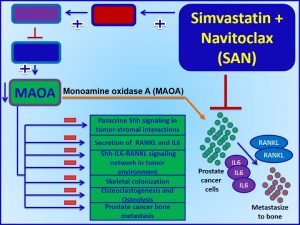
Figure 1. Mechanistic insights into how a therapeutic mix encompassing Simvastatin and Navitoclax (SAN) suppresses the expression of MAOA and stalls prostate cancer bone metastasis.
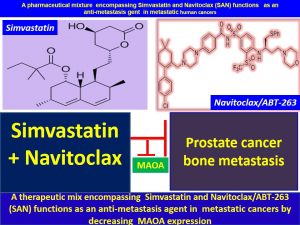
Thus, pharmacological formulations encompassing “ Simvastatin and Navitoclax (SAN) or their analogs, either alone or in combination with other known anticancer drugs, ” may be used to inhibit prostate cancer bone metastasis.
Details of the Research findings:
Idea Proposed/Formulated (with experimental evidence) by Dr L Boominathan Ph.D.
Amount: $300#
Undisclosed mechanistic information: How does a therapeutic mix encompassing Simvastatin and Navitoclax (SAN) decrease the expression of MAOA to promote metastatic prostate cancer regression?
Terms & Conditions apply http://genomediscovery.org/registration/terms-and-conditions/
For purchase and payment details, you may reach us at info@genomediscovery.org
#Research cooperation
References:
Web: http://genomediscovery.org or http://newbioideas.com/
Citation: Boominathan, L., Combinatorial therapy for attenuating prostate cancer bone metastasis: A pharmaceutical mixture encompassing Simvastatin and Navitoclax (SAN) inhibits the expression of Monoamine oxidase A (MAOA), inhibits Shh-IL6-RANKL signaling network, suppresses tumor-stromal interactions, reduces prostate cancer metastasis and prolongs survival via upregulation of its target gene, 3/March/2019, 8.33 am, Genome-2-BioMedicine Discovery center (GBMD), http://genomediscovery.org
Courtesy: When you cite, Kindly drop us a line at admin@genomediscovery.org