


What they say:
A study from the Institute for Cardiovascular Regeneration, Centre of Molecular Medicine, Frankfurt, Germany shows that “MicroRNA-34a regulates cardiac ageing and function.” This study was published, in the 7 March 2013 issue of Nature, by Prof Dimmler, Boon, and others.
Further, a recent study from the Population Health Research Institute, McMaster University and Hamilton Health Sciences, David Braley Research Bldg., Hamilton General Hospital, 237 Barton St. E., Hamilton, ON L8L 2X2, Canada shows that “Rivaroxaban with or without Aspirin in Stable Cardiovascular Disease.” This study was published, in the 27 August 2017 issue of the journal “N Engl J Med.” (the number 1 journal in “Clinical medicine” with an impact factor of 72.406), by Dr. Eikelboom, Stuart J. Connolly and others.
What we say:
On the foundation of these interesting findings, Dr L Boominathan PhD, Director-cum-chief Scientist of GBMD, reports that: Combinatorial therapy for Myocardial Infarction: A combination of Rivaroxaban and Asprin (RA) inhibits DNA damage responses, induces telomerase expression, inhibits telomere shortening, and promotes cardiomyocyte survival after myocardial infarction via up regulation of PNUTS
 [easy_payment currency=”USD”]
From Significance of the study to Public Health relevance:
Given that: (1) cardiovascular disease is the leading cause of death worldwide; (2) out of 55 million deaths that occur every year, nearly 18.33 million deaths are due to cardiovascular causes; (3) the raise of death rate, due to cardiovascular disease, has increased from 123 lakhs in 1990 to 173 lakhs in 2013; (4) 85% of people over 80 years are susceptible to cardiovascular diseases;(5) in India, in 2004, 14.6 lakhs deaths (14% of total deaths) were due to ischemic heart disease; (6) the death due to cardiovascular disease is higher in low-to-middle income countries compared to developed countries; (7) the global economic cost spent in the treatment of cardiovascular disease in 2011 was little more than 10 billion US dollars; and (8) an alarming number of people, such as 230 lakhs people, will die from cardiovascular diseases each year from 2030 onwards, there is an urgent need to find: (i) a way to induce regeneration of cardiomyocytes that were lost in Myocardial patients; (ii) a cheaper alternative to the existing expensive drugs; and (iv) a side-effect-free natural product-based drug.
From Research Findings to Therapeutic Opportunity:
Although Dr. Eikelboom’s research team has shown recently that treating patients with a combination of Rivaroxaban (2.5 mg twice daily) and Asprin (100 mg/day) ameliorates outcome of stable cardiovascular disease than treating them with either drug alone, its mechanism of action is not known.
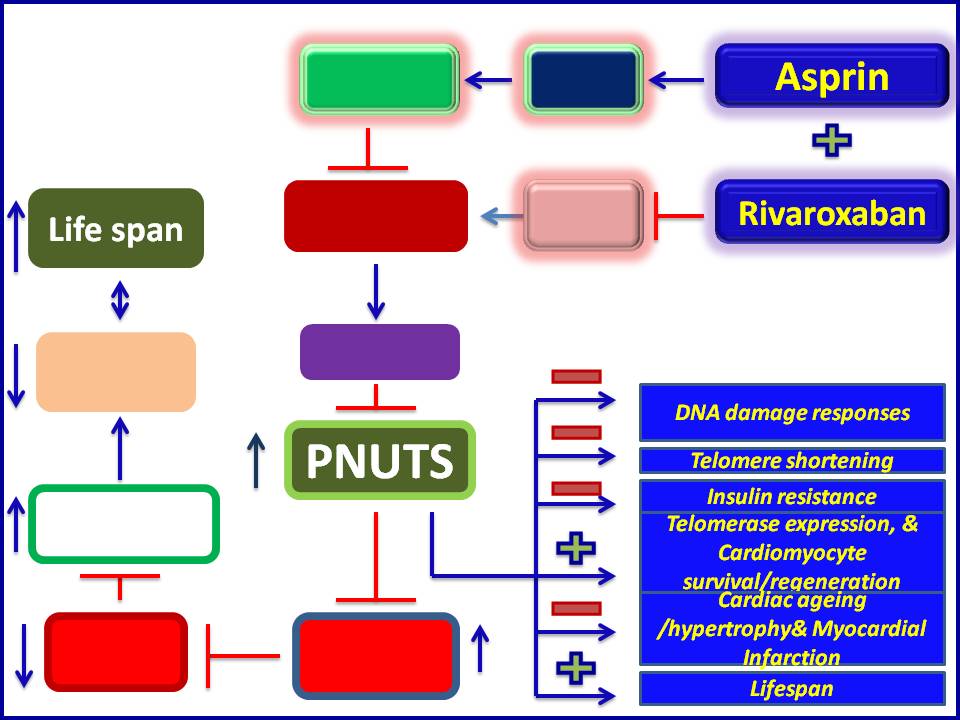
Figure 1. Mechanistic insights into how a therapeutic mix encompassing Rivaroxaban and Asprin (RA) induces the expression of PNUTS and Telomerase to prevent myocardial infarction and promote Cardiac regeneration/survival
This study suggests, for the first time, that a therapeutic mix encompassing Rivaroxaban and Asprin (RA), by increasing the expression of its target genes, it may increase the expression of PNUTS. (fig.1) . Thereby, it may: (1) inhibit DNA damage responses, (2) increase telomerase expression, (3) inhibit telomere shortening; (4) promote cardiomyocyte survival/regeneration; (5) decelerate ageing; and (6) extend life span (fig 1).
Thus, by treating patients with Rivaroxaban and Asprin (RA), one may prevent ageing-associated (or, stress-associated) decline in cardiac function. Together, this study suggests that pharmacological formulations encompassing “Rivaroxaban and Asprin (RA), or their analogs, either alone or in combination with any of the known compounds that improve myocardial function” may be used to improve cardiac function after myocardial infarction (fig. 3).
Details of the research findings:
Idea Proposed/Formulated (with experimental evidence) by:
Dr L Boominathan Ph.D.
Terms & Conditions apply http://genomediscovery.org/registration/terms-and-conditions/
Undisclosed mechanistic information: How a therapeutic mix encompassing Rivaroxaban and Asprin (RA) increases the expression of PNUTS/Telomerase
Amount: $300#
# Research cooperation
For purchase and payment details, you may reach us at admin@genomediscovery.org
References:
Web:http://genomediscovery.org or http://newbioideas.com/
Citation: Boominathan, L., Combinatorial therapy for Myocardial Infarction: A combination of Rivaroxaban and Asprin (RA) inhibits DNA damage responses, induces telomerase expression, inhibits telomere shortening, and promotes cardiomyocyte survival after myocardial infarction via up regulation of PNUTS, 27/October/2017, 12.20 am, Genome-2-Bio-Medicine Discovery center (GBMD), http://genomediscovery.org
Courtesy: When you cite drop us a line at admin@genomediscovery.org