


What they say: Introduction:
A recent study from the Department of Genetics, Paul F. Glenn Laboratories for the Biological Mechanisms of Aging Harvard Medical School, Boston,USA; and Department of Pharmacology, School of Medicine, The University of New South Wales, Australia shows that Sirtuin-2 induces the checkpoint kinase BubR1 to increase lifespan. This study was published, in the 1 July 2014 issue of the journal “EMBO”, by Prof Sinclair, North BJ, and others.
What we say:
On the foundation of this interesting finding, Dr L Boominathan PhD, Director-cum-chief Scientist of GBMD, reports that: Lifespan extension therapy: 15-deoxy-Delta,12,14-prostaglandin J2 (15d-PGJ2) may increase life span via up-regulation of its target gene BubR1, 16/November/2017, 10.09 am

What is known?
15-deoxy-Delta,12,14-prostaglandin J2 (15d-PGJ2) has been shown to possess anti-hyperglycemic property. However, the exact mechanism of action is far from clear.
From Research Findings to Therapeutic Opportunity:
This study suggests, for the first time, that 15-deoxy-Delta,12,14-prostaglandin J2 (15d-PGJ2), by increasing the expression of its target gene, it may: (a) increase the expression of BuBR1; (b) decrease the expression of p70 S6 Kinase; and (c) regulate the expression of a number of longevity-promoting molecules (Fig. 1).
[easy_payment currency=”USD”]
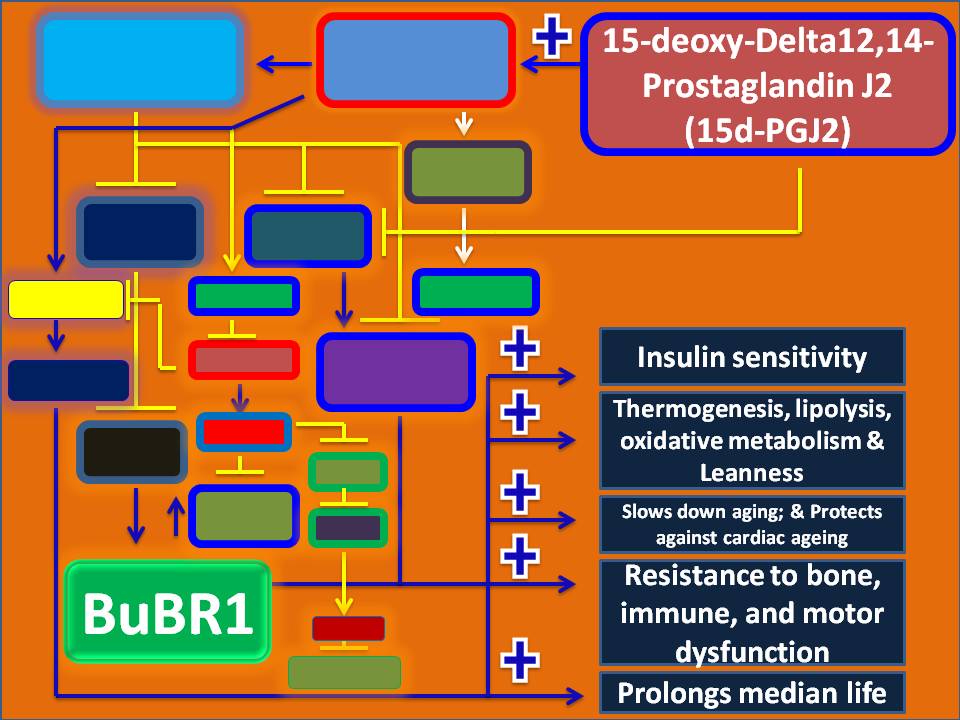
Figure 1. A therapeutic mix encompassing 15-deoxy-Delta,12,14-prostaglandin J2 (15d-PGJ2) may extend mammalian life span via up regulation of BuBR1 and down regulation of p70 S6 Kinase
Thereby, it may: (1) increase insulin sensitivity; (2) attenuate cognitive impairment; (3) delay diseases of aging; (4) slow down cardiac aging; (5) promote resistance to bone, immune and motor dysfunction; (6) promote tissue rejuvenation; and (7) prolong median life span. Thus, pharmacological formulations encompassing ” 15-deoxy-Delta,12,14-prostaglandin J2 (15d-PGJ2) or its analogues, either alone or in combination with other drugs” may be used to extend the lifespan of an individual (fig. 1).
Details on the research findings:
Idea Proposed/Formulated (with experimental evidence) by:
Dr L Boominathan Ph.D.
Amount: $500#
Undisclosed mechanistic information: How a pharmaceutical mix encompassing 15-deoxy-Delta,12,14-prostaglandin J2 (15d-PGJ2) increases the expression of BubR1 and extends mammalian life-span
Terms & Conditions apply http://genomediscovery.org/registration/terms-and-conditions/
# Research cooperation
References:
Web: http://genomediscovery.org or http://newbioideas.com
Citation: Boominathan, L., Lifespan extension therapy: 15-deoxy-Delta,12,14-prostaglandin J2 (15d-PGJ2) may increase life span via up-regulation of its target gene BubR1, 16/November/2017, 10.09 am, Genome-2-Bio-Medicine Discovery center (GBMD),
Courtesy: When you cite drop us a line at admin@genomediscovery.org