

National Science day special
*********
We wish everyone a very happy national science day. On this special occasion, we are happy to announce that Bio-Med ideas posted today (28/February/2017) will be available to the use of Scientists/Professors/Teachers/Physicians/Researchers for free. So, there will be no terms and conditions for the ideas posted today (28/February/2017). Each idea posted will be served first come, first served basis. Write to info@genomediscovery.org for more details.
Dr L Boominathan PhD
President & CSO, GBMD.
************************************************************************************
From Significance of the study to Public health relevance:
Given that: (i) each year nearly 14 million people are diagnosed with cancer globally, and little more than half of them will die; (ii) cancer deaths globally are expected to be doubled by 2030; (iii) cancer treatment causes the highest economic loss compared to all the known causes of death worldwide, there is an urgent need to find: (i) a way to prevent an individual from being susceptible to cancer by strengthening his/her own immune system (Cancer immunotherapy); (ii) a cheaper alternative to the existing expensive anticancer drugs; (ii) a side-effect-free natural product-based drug; (iii) increase the therapeutic index of anticancer drugs; and (iv) a way to effectively treat and prevent metastatic progression and relapse of advanced/drug-resistant cancers.
Research findings to Therapeutic opportunity:
A number of studies suggest that Rapamycin/Sirolimus functions as an anticancer agent. However, the mechanism of action is far from clear.
This study suggests that Rapamycin/Sirolimus, by decreasing the expression of its target genes, it may increase the expression of cancer suppressor KRIT1/CCM1 (figs. 1-4).
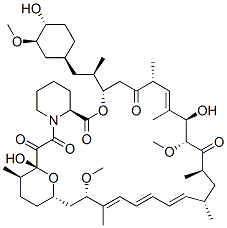
Fig1. The chemical structure of Rapamycin/Sirolimus. Rapamycin/Sirolimus may function as an anticancer agent by increasing the expression of KRIT1/CCM1 and by sensitizing the cancer cells to apoptosis
Thereby, it may inhibit migration, invasion and metastasis of cancer cells. Thus, pharmacological formulations encompassing “Rapamycin/Sirolimus or its analogues either alone or in combination with other anticancer drugs” may be used to inhibit the progression of invasive tumors; and to sensitize cancer cells to apoptosis.
Details of the research findings:
Idea Proposed/Formulated (with experimental evidence) by:
Dr L Boominathan Ph.D.
Undisclosed mechanistic information: How Rapamycin/Sirolimus increases the expression of apoptotic inducer KRIT1/CCM1
References:
Citation: Boominathan, L., Small molecule-based therapy for Metastatic cancers: Rapamycin (also known as Sirolimus), an immuno suppressor and a longevity promoting drug, increases the expression of tumor suppressor KRIT1/CCM1, sensitize cancer cells to apoptosis, and inhibits migration, invasion and metastasis of cancer cells via down regulation of its target gene, 28/February/2017, 9.42 am, Genome-2-Bio-Medicine Discovery center (GBMD), http://genomediscovery.org
Web: http://genomediscovery.org or newbioideas.com/
Courtesy: When you cite drop us a line at info@genomediscovery.org